|
|
|||
|
What
is Watsu? |
|
||
|
|
Since its
discovery 20 years ago, the form of aquatic bodywork created by Harold
Dull known as WatsuTM, water Shiatsu, has been adopted and
practiced widely, not only in this country but worldwide. The
technique's growing popularity is largely due to the fact that each
Watsu session is not only a massage, but also a profound experience
that causes many healing "shifts" on the physical, emotional and
spiritual levels. Healing can occur not only for the receiver of Watsu,
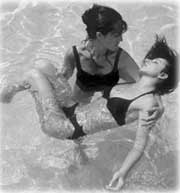
but also for the giver. Each Watsu session takes place in chest-high warm water, and involves both massage an a series of flowing, dance-like movements. While beginning Watsu givers usually rely on a learned sequence of moves, more advanced practitioners often use the "free flow" method. This spontaneous approach allows the giver to become increasingly open and free to intuit whatever movements emerge in response to the client's needs at the moment. Today's teachers and practitioners of Watsu, certified by the Worldwide Aquatic Bodywork Association, can be found in many cities, both in this country and in Europe, Latin American and Japan. Although there is a growing number of certified Watsu teachers, perhaps the technique's best known instructor is Harold Dull, the poet and linguist who created Watsu in 1980. Dull coined the name of his invention from "water" and "Shiatsu," its two major components. Harold Dull's inspiration for inventing Watsu began when he traveled to Japan in the late 1970s to study Zen Shiatsu, a form of massage than emphasizes stretches and point work to help release blockages along the body's meridians. When he returned home to Harbin Hot Springs, California, he began perfecting his Shiatsu technique while floating his clients in the hot spring's warm water. Gradually a completely new kind of bodywork emerged. Dull included his invention, under the name WatsuTM in the curriculum of workshops at his School of Shiatsu and Massage at Harbin. Soon he had several hundred Watsu students each year. He found that in aquatic massage the receiver's body would glide easily and naturally into many relaxing positions impossible on land. Floating horizontally, supported by the therapist's arms and the soft water, the spine was freed from its gravitational prison. This freeing of the spine is essential to each Watsu session, for it allows deeply healing energy movement that can lead to release of long-held physical and emotional tensions. Although Harold Dull is a tall, strong person, he found that when he began teaching Watsu to others that the natural buoyancy of the human body in water makes it possible for even a smaller person to give a much larger one a Watsu session. He encouraged his students to develop their own creative Watsu styles, according to their individual body types and personal preferences. Watsu is currently popular not only at Harbin Hot Springs, but in many other settings in this country and abroad. It is offered by massage therapists at several spas, including Ten Thousand Waves in Santa Fe and Two Bunch Palms near Palm Springs. Watsu is also used by many physical therapists, such as those at the internationally known rehabilitation institute, Timpany Center in San Jose. In fact, Watsu seems to blend well with almost any other healing modality. It is a healing technique whose time has come. Watsu classes are available at the School of Shiatsu & Massage at Harbin Hot Springs in Middletown, CA. The World Wide Aquatic Bodywork Association offers certification at the 100 hour, 500 hour and 1,000 hour levels to Watsu practitioners. For more information call 800-693-3296. Related Info: Natural Relief from Back Pain A Glossary of Bodywork Therapies Polarity Therapy Vibrational Healing Massage Therapy Ortho-Bionomy Somatics: A Revolutionary Method Bodywork Pracitioners MORE
HEALTH ARTICLES Home  Health Directory Articles Index Interviews Health Directory Articles Index InterviewsReviews Links About Share Guide Contact us |
||
|
|
|||
|
|
|
||


 If
you liked this article, you'll
love The Share Guide's
If
you liked this article, you'll
love The Share Guide's